REVIEW · ROME
From Rome: Guided Tour to Pompeii with priority admission
Book on GetYourGuide →Operated by Napoli Official Tour · Bookable on GetYourGuide
Pompeii looks small, until you walk it. This Rome-to-Pompeii day trip is built for people who want the big sights fast: a fast train to the ruins, priority admission to skip the long ticket line, and a focused 2-hour guided walk once you arrive.
I especially like how the guide gives you the story behind what you’re seeing, not just a list of monuments. You’ll hit the main street (Via dell’Abbondanza), the forum area with major public buildings, and key stops like the large theatre and House of Menander. One real consideration: you’re only inside on a guided window, so if you want to wander slowly and stop for lots of photos in every doorway, you may feel a bit time-pressed on a half-day plan.
In This Review
- Key Highlights You’ll Feel Right Away
- Pompeii in Half a Day: The Fast-Train Setup From Rome
- Priority Admission at Pompeii: Where the Time Savings Go
- The 2-Hour Guided Walk: Via dell’Abbondanza and the Main Public Sights
- Forum to Houses: Theatre, Menander, and the Details You’ll Remember
- The Pompeii Story the Guide Tells: Lost, Preserved, Rediscovered
- Real-World Logistics: What a 6-Hour Plan Means for You
- Guides Matter: When the Tour Uses Clever Timing
- Who This Tour Fits Best (and Who Might Want More Time)
- Price and Value: Is $283.21 Worth It?
- Final Decision: Should You Book This Priority Pompeii Tour?
- FAQ
- How long is the Pompeii tour from Rome?
- What time does the tour leave Rome Termini?
- How long is the guided time inside Pompeii?
- Does this tour include skip-the-line admission?
- What transportation is included?
- What languages are the guides available in?
- What should I bring?
- Is food included?
- Does the tour run in bad weather?
Key Highlights You’ll Feel Right Away
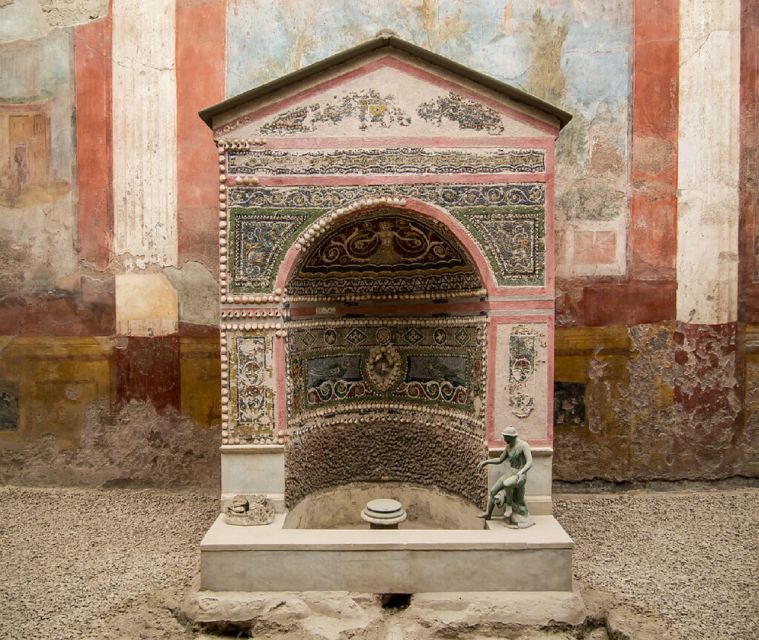
- Priority admission at Pompeii so you can get moving instead of queuing
- A 2-hour guided walking route focused on Pompeii’s must-see highlights
- Fast round-trip train from Rome Termini with transfers handled
- An eruption explanation that makes the site make sense (ash, pumice, and preservation)
- Route management by the guide to help reduce time spent crossing crowded group patterns
Pompeii in Half a Day: The Fast-Train Setup From Rome
The whole appeal here is momentum. You start in central Rome at Rome Termini, and the plan is to get you to Pompeii quickly on a fast train rather than spending a chunk of your day stuck on the road. With a total duration of about 6 hours, this trip is designed as a half-day experience at the ruins, with the train doing the heavy lifting for your schedule.
The departure is scheduled at 7:40 am from Termini. Do yourself a favor and arrive 30 minutes early. Trains can involve finding the right platform, getting through any station flow, and then lining up with your transfer team. If you’re traveling with kids or you just don’t want stress, that early arrival buffer is worth it.
Once you arrive near Pompeii, you meet your professional guide close to the entrance of the ancient city. That matters because Pompeii is spread out, and if you start “solo,” you can waste time getting your bearings. With a guide, you’re pointed in the right direction from the first steps.
You can also read our reviews of more guided tours in Rome



Priority Admission at Pompeii: Where the Time Savings Go
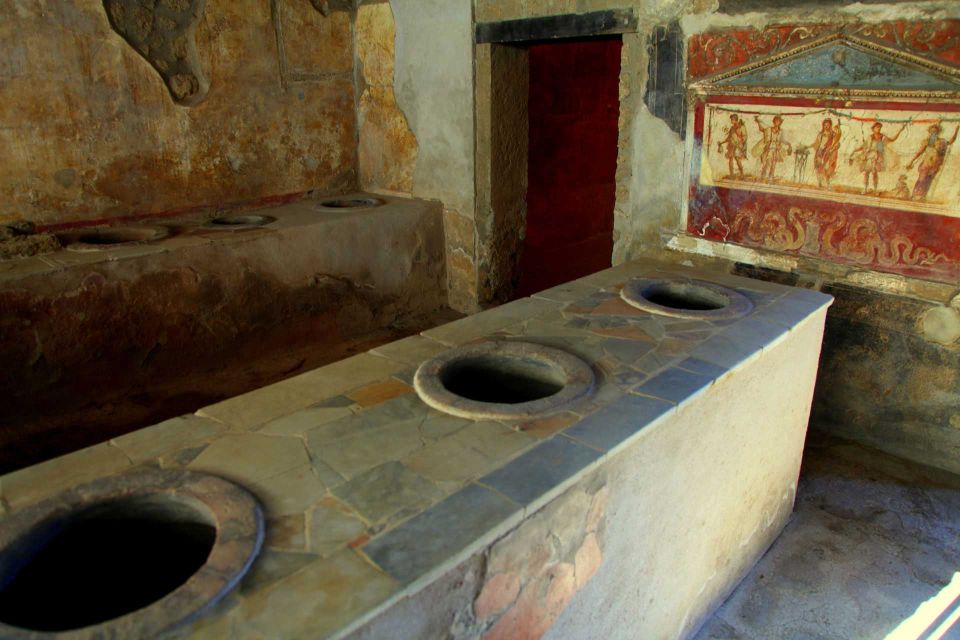
Skip-the-line access isn’t just a convenience. At Pompeii, it can change your entire mood. Instead of spending your best hours watching other people buy tickets, you start the experience with your guide right where it counts: at the entrance of the site.
You’ll use entrance ticket with skip-the-line admission, so you can jump into the walking tour without the usual queue stretch. Then, after an introduction, the guide takes you along a route that covers the big public spaces and the kind of domestic details that make Pompeii feel personal.
This is one of the spots where the price makes more sense. At $283.21 per person, part of what you’re paying for is not only the ticket, but the entire “get you in, get you moving” structure: fast train, transfers, guide time, and the entry benefit that protects your schedule.
The 2-Hour Guided Walk: Via dell’Abbondanza and the Main Public Sights
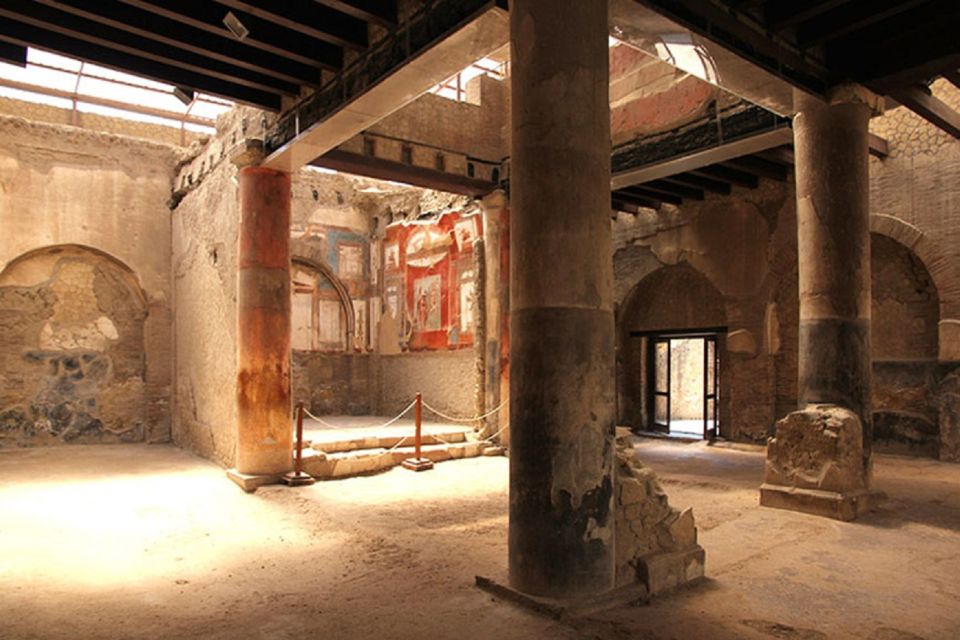
The guided portion is 2 hours, and it’s not random. You’re walked through Pompeii’s core zones in a way that helps you understand how the city worked.
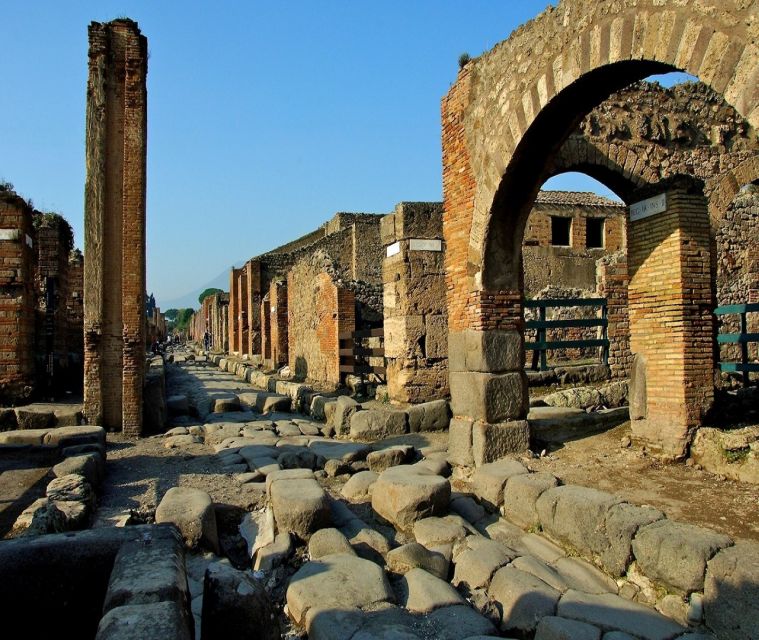
A key highlight is Via dell’Abbondanza, Pompeii’s main street. This is where the ruins start to feel like daily life instead of just stone. You’ll pass ancient shops and snack bars along this main road, and it’s easy to imagine people moving through the city for errands, food, and errands-in-between.
From there, the tour typically leans into the civic centerpiece. On one end of the route you’ll reach the forum, and the guide helps connect the dots between Pompeii and the larger Roman world. You’ll see major buildings and spaces, including:
- a large basilica
- the Temple of Jupiter
- forum baths
These are the kinds of places where Pompeii goes beyond “pretty ruins.” You start to understand why the forum mattered: it was where public life, religion, and social activity met.
Then the route moves to the other end with a very different kind of stop: the Porta Sarno necropolis. The word necropolis might sound technical, but the practical effect is simple. Pompeii isn’t only about everyday streets and big temples. It also includes how people thought about death and remembrance.
Forum to Houses: Theatre, Menander, and the Details You’ll Remember
Pompeii’s power is in the mix of scale and detail, and your 2-hour plan is built to show both.
You’ll pass by the large theatre, built for about 5,000 seats. That detail is a quick reality check: this wasn’t a tiny outpost. People came here in large numbers for events, and the theatre is one of the ruins that makes the community feel real.
You’ll also get a look at the House of Menander, a villa-like home owned by one of the city’s more important families. This is where the guide’s job becomes extra important. A house on its own can feel confusing. With a guide, you get the logic of the space, the feel of daily routines, and the meaning behind the way rooms and features are arranged.
One thing I like about this approach is that it avoids turning Pompeii into only a walking postcard list. The guide points out what to notice, so you’re not just moving from one wall to another. You’re building a simple mental map of how a Roman city was organized.
And yes, this is the kind of stop where you’ll likely want to pause and look more closely than you can during a guided schedule. If that’s you, treat the tour as your framework, then decide later whether you want to circle back on your own during any free time you might have outside the guided window.
The Pompeii Story the Guide Tells: Lost, Preserved, Rediscovered
The introduction is not an optional warm-up. It’s what turns Pompeii from scenery into understanding.
You’ll get an explanation of how the city was lost and then rediscovered, and the core event is the eruption of Mount Vesuvius in the first century AD. The guide also explains the preservation conditions: some parts of Pompeii were covered by ash and pumice, with an estimated depth of up to six metres.
That detail matters because it’s part of why you can still recognize everyday objects and spaces. Pompeii didn’t just get damaged. It was protected—frozen under a thick layer. The guide’s storytelling helps you connect what’s visible now to what once filled the rooms and streets.
What I find practical about this is how it changes your attention while you walk. Instead of wondering what a building used to be, you start noticing how Pompeii’s layout supported daily habits: where people gathered, where they ate, where they worshipped, and where communities marked important life moments.




Real-World Logistics: What a 6-Hour Plan Means for You
This trip is a good fit if you like tight structure and hate wasting daylight. It’s also a good fit if you’re traveling from Rome and don’t want to manage trains, entry tickets, and routing on your own.
Here’s how the day is meant to flow:
- Meet at Termini and board the fast train to Pompeii (the ride is under 2 hours)
- Meet your guide close to the entrance and use priority admission
- Do a 2-hour guided walking tour through the main highlights
- At the end, you can pick up food to bring on the train
- Return quickly to Rome
That last bit is useful. Since food and drinks aren’t included, you should plan on either buying something before you board or grabbing it at the end of your tour. The option to get food for the train means you’re not stuck trying to hunt for a meal while the day is slipping away.
Also note the tour runs rain or shine. Pompeii is outdoor walking, so bring practical footwear and dress for weather. If it’s wet, the ground can be slippery, and you’ll be grateful for shoes that grip.
One more practical note: you need to provide full names of all participants via email or WhatsApp Line to prebook the fast train tickets. If you’re booking last-minute or you’re traveling as a group, do this immediately so your tickets match your passport/ID.
Guides Matter: When the Tour Uses Clever Timing
Good guides don’t just explain monuments. They manage crowds and movement so your time feels efficient.
In this experience, I’ve seen examples of guides like Lívia using smarter routing choices. On a busier season like Easter weekend, she started the tour from the end to the beginning so you’d spend less time threading through clusters of other groups. That’s not magic, it’s strategy: it reduces backtracking and helps your walk feel smoother.
You’ll also meet guides such as Fabio, who’s been described as fantastic, and that’s the kind of difference you want. Pompeii rewards patience, but a 2-hour guided window needs a guide who can keep it moving while still making the details land.
Your take-away: if you’re booking this tour, you’re paying for the structure. A strong guide turns that structure into a better experience than you could easily replicate by yourself in a short half-day.
Who This Tour Fits Best (and Who Might Want More Time)
This is a strong option for:
- First-timers who want Pompeii’s biggest highlights without planning the day from scratch
- People who value logistics handled for them: train tickets, transfers, entry, guide
- Travelers who like a guided framework and then might explore on their own later (if your schedule allows)
It might not be ideal if:
- You want a long, slow museum-style visit with lots of free roaming
- You’re hoping for hours of detailed house-by-house study
- You’re easily stressed by early starts, since 7:40 am departure is part of the plan
The reason I say that gently: Pompeii can swallow time. With only 2 hours guided, you’ll cover essentials, but you’ll also feel the limit. If that limit worries you, you might prefer a longer tour later in the day or a plan that includes more independent exploration time.
Price and Value: Is $283.21 Worth It?
Let’s talk value in plain terms. At $283.21 per person, you’re not paying only for a guide at Pompeii. You’re also paying for:
- Fast round-trip train tickets from Rome Termini
- Transfers from/to the train station
- Priority admission to skip the long ticket line
- A 2-hour guided visit inside Pompeii
If you were to DIY this, the cost can drop, but so does the certainty. You’d be coordinating train times, buying tickets, managing entry queues, and planning a route that won’t waste your limited hours. This tour bundles those pieces into one plan, which can be a big win if you’re on a strict schedule or you don’t want the stress tax.
I think it’s best seen as: you’re paying for time protection and decision-light travel. That’s worth it for many people, especially on a first visit.
Final Decision: Should You Book This Priority Pompeii Tour?
Book it if you want a high-efficiency Rome-to-Pompeii day with skip-the-line entry, a professional guide, and a route that hits the essentials like Via dell’Abbondanza, the forum, the Temple of Jupiter, forum baths, the large theatre, and the House of Menander.
Skip it (or consider a different format) if your travel style is slow wandering and deep independent exploration. With only 2 hours at Pompeii in a guided structure, you’re getting a smart highlight reel, not a full, leisurely revisit of every corner.
If you’re the type who likes to see a lot without turning your day into logistics homework, this tour is a solid choice.
FAQ
How long is the Pompeii tour from Rome?
The total experience is about 6 hours, including train time and the guided visit.
What time does the tour leave Rome Termini?
Departure is scheduled at 7:40 am from Rome Central Station of Termini. You should arrive 30 minutes early.
How long is the guided time inside Pompeii?
You get a 2-hour guided visit in Pompeii.
Does this tour include skip-the-line admission?
Yes. It includes entrance ticket with skip-the-line admission and priority admission.
What transportation is included?
Included: fast train tickets round trip, plus transfer from/to the train station.
What languages are the guides available in?
The live tour guide is available in English, Spanish, French, and Italian.
What should I bring?
Bring your passport or ID card (the information also notes children need passport/ID). Wear clothing and shoes suitable for walking.
Is food included?
No. Food and drinks aren’t included, but you can buy food to bring with you for the train after the tour.
Does the tour run in bad weather?
This tour runs rain or shine.