REVIEW · ROME
Rome: Ancient Jubilee in the 4 Major Basilicas
Book on GetYourGuide →Operated by Roman Vacations · Bookable on GetYourGuide
Four Holy Doors in one day.
This Jubilee-style Rome walk is built around entering the Holy Doors at the city’s top Papal basilicas, like pilgrims have done since 1300. I especially like the “expert Catholic guide” approach, since you’re not just looking at marble—you’re getting the meaning behind what you’re seeing, including moments tied to early Jubilee traditions.
I also like the pacing for people who want structure: a 5-hour loop, guided visits that run about an hour each inside the basilicas, plus private air-conditioned transport between stops. One possible drawback: you may not hear your guide as clearly inside the churches. One guide case noted that the guide sometimes had to whisper, and there was no audio device, so plan to ask questions early and keep your voice level up when you’re near him.
In This Review
- Key points to know before you go
- Jubilee pilgrims, but with an organized route
- St. Peter’s Basilica: Pietà, relics, and the tomb beneath the High Altar
- St. Paul Outside the Walls: chains, an excavated sarcophagus, and the old Theodosian basilica
- St. John Lateran: Rome’s Cathedral and the 1300-era altar placement
- Santa Maria Maggiore: golden interior, crib relics, popes buried here, and Salus Populi Romani
- Timing and transport: making 5 hours feel possible in Rome
- Price and value: is $283.21 worth it?
- Practical rules: clothing, ID, and planning for small friction
- Who this Jubilee pilgrimage is best for
- Should you book this tour?
- FAQ
- Which basilicas are included in the tour?
- Do you enter through Holy Doors at each stop?
- How long does the tour take?
- What is the meeting point?
- Where does the tour end?
- Is food included?
- What language is the guide?
- What should I wear?
- Is transport between sites included?
- What identification should I bring?
- Is the booking flexible?
Key points to know before you go

- Holy Doors at all four Papal Major Basilicas: The whole point is the official pilgrimage route in a Jubilee year.
- A guided, Catholic-focused route: You’ll hear stories tied to relics, altars, and the Jubilee tradition begun in 1300.
- Air-conditioned car transport between churches: It saves time and keeps the day sane in Rome traffic.
- Expect big-church time limits: Each basilica is about an hour with an interior tour.
- Bring church clothes and a backup plan for sound: Shoulders and knees covered matter, and you may need to get closer to hear.
Jubilee pilgrims, but with an organized route
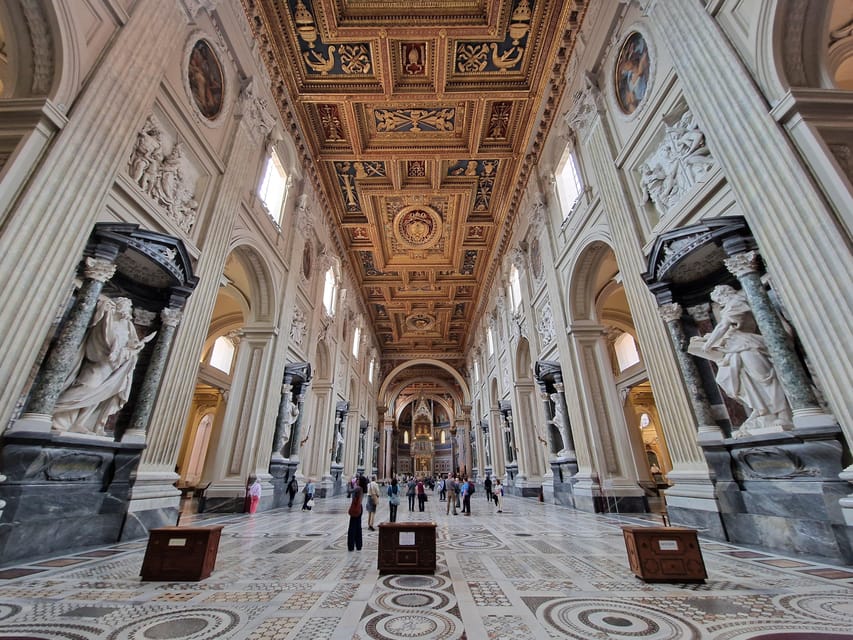
The Jubilee tradition in Rome dates to the year 1300, when Pope Boniface VIII encouraged pilgrims to visit the four most important churches and pass through their holy doors. This tour is designed to do exactly that in one packed morning or afternoon: you work your way through Rome’s four Papal Major Basilicas, one guided interior stop at a time, each with a Holy Door entry.
What makes this experience feel real is that it’s not just sightseeing. You’re moving through places connected to centuries of prayer and pilgrimage, and you’re given a framework for why they matter. Even if you’re not deep into Catholic theology, it’s still a strong way to read Rome: you learn what to notice and what symbolism to look for.
You should also know the order of basilicas can change due to traffic or accessibility. That’s normal in Rome, and it’s one of the reasons this tour uses transport and a guide to keep you on track.
You can also read our reviews of more tours and experiences in Rome.

St. Peter’s Basilica: Pietà, relics, and the tomb beneath the High Altar
St. Peter’s is the obvious headline, but the tour experience gives you more than the usual “big dome, big crowd” moment. Once you enter, the guide walks you through the interior with a focus on Michelangelo’s Pietà, major saints connected to the church, and the history tied to the space.
A key part here is the connection to St. Peter himself. The tour route specifically points out the idea that St. Peter’s body lies beneath the High Altar area. Whether you already know the story or you’re picking it up for the first time, it changes how you look at the basilica. The central altar area stops feeling abstract and starts feeling like the center of a living tradition.
Practical note: St. Peter’s can be loud and crowded. If sound is an issue for you, position yourself where the guide’s voice carries. One guide example mentioned whispering inside the basilicas, so don’t assume you’ll hear everything from the back of the group.
St. Paul Outside the Walls: chains, an excavated sarcophagus, and the old Theodosian basilica

Next you move to St. Paul Outside the Walls, the home base for many visitors who want a different Roman vibe than Vatican City. Here, the tour emphasizes the remains of St. Paul and shows key items connected to his incarceration in Rome.
You’ll see the chains that bound St. Paul during his imprisonment and house arrest in Rome, and you’ll also be guided past what’s described as his newly excavated sarcophagus. Those details make the visit feel anchored in narrative, not just architecture.
The tour then shifts into the basilica itself—called an ancient Theodosian basilica in the description—so you’re not only hearing the dramatic story of a prisoner. You’re also learning how the church developed and how the space functions as a place of veneration over time.
This stop is a good reminder that Rome isn’t only about rulers and emperors. It’s also about people whose lives were shaped by faith, conflict, and the long memory of places.
St. John Lateran: Rome’s Cathedral and the 1300-era altar placement

The Arch-Basilica of St John Lateran is the Cathedral of Rome, and the tour treats it as the “mother church” of the Catholic world. That’s not just a title—it comes with a different feeling than the other stops, because it’s framed as the highest-ranking basilica in the group.
Inside, you’ll get a guided look at the interior and its history, with attention to the ancient mosaics. The tour also includes a very specific Jubilee-related moment: you’ll stand before the heads of Sts Peter and Paul, which the description says were brought into the basilica and placed above the altar in the year 1300.
That kind of detail matters because it ties your visit to a particular moment in time. In a city full of layers, it’s easy to blur everything together. Here, you’re given a date to hold onto, which makes the place easier to remember after you leave.
If St. Peter’s feels like the global stage, St. John Lateran often feels like the administrative heart of the pilgrimage story. You end this part with a stronger sense of how the Jubilee route is organized around authority and tradition.
Santa Maria Maggiore: golden interior, crib relics, popes buried here, and Salus Populi Romani

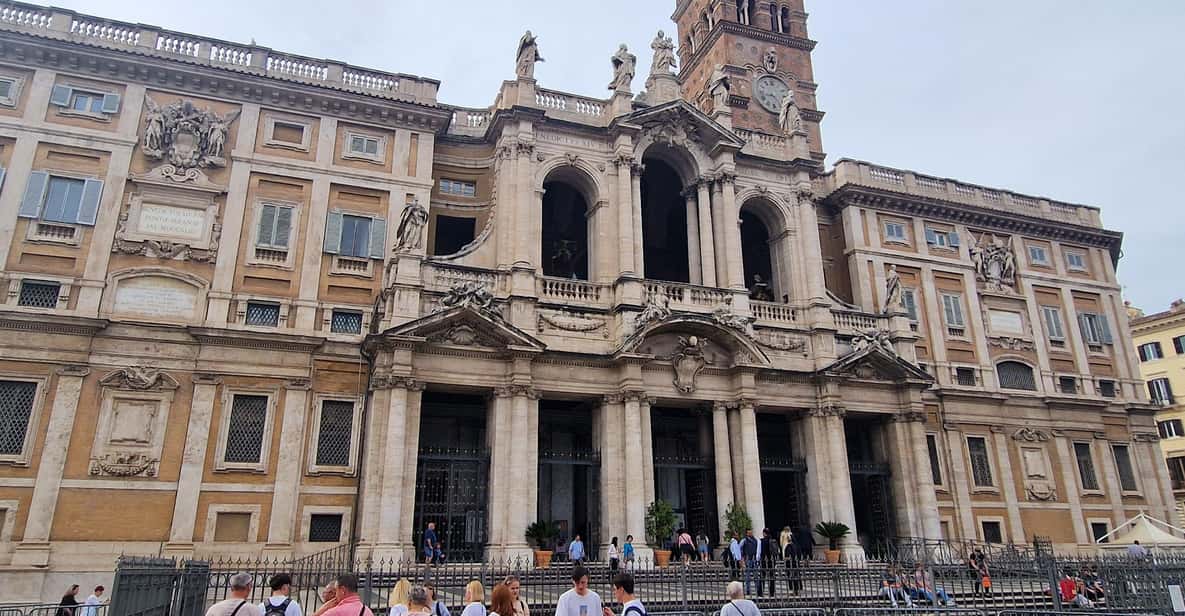
Santa Maria Maggiore is where the day turns into something more luminous. The tour description calls it perhaps the oldest church dedicated to Mary in Rome, and certainly among the most important. The focus here is the church’s golden interior, plus a set of distinctive features you can’t reliably “guess” by walking in on your own.
You’ll learn about different popes buried here, and the tour highlights relics of the crib of the Nativity of Christ. It also points you toward the miraculous icon of Salus Populi Romani—another item that gives the visit a specific devotional center.
If you’re the type who likes to know what you’re looking at, this is a great stop. Instead of wandering until you find something impressive, you get guided attention to the exact things that make this basilica part of the Jubilee pilgrimage.
Also, since you’re finishing the loop here, it works well psychologically. You end with a church that’s described as visually striking and packed with meaning, rather than ending on a practical footnote.


Timing and transport: making 5 hours feel possible in Rome

This tour lasts about 5 hours, with around an hour guided inside each basilica. Between sites, you use private air-conditioned transport, with a chauffeured car included in the tour. That setup is a big deal in Rome, because walking between these points can eat up time fast.
Why this matters for you: it protects the quality of your visits. If you’re doing these churches on your own, you can spend most of the day in queues, crossing streets, and trying to find your way to the next entrance. With a guide and a vehicle, you spend more time inside the places that count for the Jubilee.
There’s one more timing reality to plan around. You’re checking in and then departing promptly, and you’ll be moving through churches where people often linger. If you go in thinking this is a relaxed stroll, you might feel slightly rushed. If you go in expecting a structured pilgrimage, you’ll probably enjoy the rhythm.
Price and value: is $283.21 worth it?

At $283.21 per person, this isn’t a budget pick. But it can still be good value, depending on what you want from Rome.
Here’s what you’re paying for, based on what’s included:
- Entry to each basilica
- An expert local guide
- Transport between stops (private air-conditioned car)
The Holy Door experience is also the main “product.” If your goal is the official Jubilee route through four major basilicas in one go, this tour packages the hard part: navigation, entrances, and interpretation.
Where value gets tricky is communication. If you can’t hear the guide well inside the basilicas, the experience becomes more visual than guided. One account described the guide whispering and sometimes hard-to-hear instructions. If you’re someone who learns best by listening, take an active approach: get closer, ask questions early, and watch for the guide’s prompts.
So, is it worth $283.21? For many people who want the complete Jubilee loop with guidance and transport, yes. If you prefer to move at your own pace and you’re comfortable researching entrances and basilica details ahead of time, you could potentially spend less on your own. But you’d give up the convenience and the organized pilgrimage feel.
Practical rules: clothing, ID, and planning for small friction

There are a few “don’t get turned away” issues you should handle before you arrive.
- Clothing rules: shoulders and knees must be covered to enter the basilicas. Sleeveless shirts and short skirts are not allowed.
- Pets: pets are not allowed.
- Photo ID: proof of identification may be required, so bring a valid form of photo ID for each guest.
You’ll also want to be ready for Rome logistics. The tour checks in at the meeting point 15 minutes before departure, and late arrivals don’t get a rescue. Meeting instructions are specific: arrive at the fountain on the wall of Piazza Giovanni XXIII, near Lungotevere Vaticano, and look for the guide holding an orange sign with a lion head.
One helpful real-world consideration: if you need bathroom time, don’t wait until you’re desperate. A guide example mentioned that restroom options weren’t clearly covered in the moment, so I’d treat this as an event-day plan. Ask your guide early where restroom opportunities might exist during the route.
And yes, you’ll likely do some crossing and maneuvering in traffic-heavy areas. One account described a tense street crossing moment, so stay alert and don’t assume cars and motorcycles will slow exactly when you want them to.
Finally, Rome is Rome: the tour runs in all weather unless a site closes for safety. Bring bottled water, sunscreen, a hat, and an umbrella if weather looks changeable.
Who this Jubilee pilgrimage is best for

This tour fits you if:
- Your priority is the Jubilee pilgrimage path, not just seeing famous churches.
- You want guided context for St. Peter’s, St. Paul Outside the Walls, St. John Lateran, and Santa Maria Maggiore.
- You value organized transport so your day doesn’t turn into a logistics puzzle.
It’s also a good fit if you like religious art and symbols and want help reading what you see—like Michelangelo’s Pietà at St. Peter’s or the specific devotional items at Santa Maria Maggiore.
If you’re traveling with limited time in Rome and you want a concentrated payoff, this structure helps. Four Major Basilicas in one day is a lot, and the tour is designed to make it workable.
Should you book this tour?
Book it if you want the full four-Holy-Door Jubilee route with guidance and private transport, and you’re comfortable with a structured 5-hour schedule. The value is strongest when your main goal is the pilgrimage experience itself.
Skip or reconsider if you know you struggle with hearing guides in big echoing spaces, or if you prefer slow, independent exploring where you can pause as long as you like. In that case, you might still enjoy the basilicas, but you’d want your own plan for entrances and timing.
Bottom line: for people who want the Jubilee tradition done in one clean, guided sweep, this is a very logical choice.
FAQ
Which basilicas are included in the tour?
The tour includes four Papal Major Basilicas: St. Peter’s Basilica, St. Paul Outside the Walls, the Basilica di San Giovanni in Laterano (St. John Lateran), and Basilica Papale di Santa Maria Maggiore (St. Mary Major).
Do you enter through Holy Doors at each stop?
Yes. The experience is specifically set up to enter each basilica through its Holy Door during the Jubilee tradition.
How long does the tour take?
The duration is 5 hours. Starting times vary, so you’ll need to check availability for the exact schedule.
What is the meeting point?
You meet at the fountain on the wall of Piazza Giovanni XXIII, nearby Lungotevere Vaticano. Look for the guide holding an orange sign with a lion head.
Where does the tour end?
It finishes at the Papal Basilica of Saint Mary Major. The activity details also indicate it ends back at the meeting point, so you’ll receive detailed instructions after booking to confirm the exact end point.
Is food included?
No. Food and drink are not included in the tour price.
What language is the guide?
The live tour guide is in English.
What should I wear?
Shoulders and knees must be covered to enter the basilicas. Short skirts and sleeveless shirts are not allowed.
Is transport between sites included?
Yes. Transport during the tour is included, and the description notes private air-conditioned chauffeured cars between stops.
What identification should I bring?
Proof of identification may be required, so bring a valid form of photo ID for each guest.
Is the booking flexible?
There is free cancellation up to 24 hours in advance for a full refund, and you can reserve now and pay later.